
What a Difference a Century Makes: 1916
By: M. Callahan
1916 US Population: 101,961,000
President:
Woodrow Wilson
Vice President:
Thomas R. Marshall
Sect. of State: Robert Lansing
Virginia Governor: Henry Carter Stuart
Chief Justice Supreme Court: Edward Douglass White
Speaker of the House: Champ Clark (D-Missouri)
VA Senators: Charles A. Swanson & Thomas Martin
BORN in 1916
Olivia de Havilland, Gregory Peck, Lawrence M. Leonard, James Herriot, Walter Cronkite, Tokyo Rose, Eugene McCarthy
DIED in 1916
Eduard Strauss, Rasputin, Jack London, Henry James, Thomas Eakins, Hetty Green
HISTORICAL EVENTS
- Battle of Verdun is fought. Battle of the Somme follows in July. Verdun, was the longest and one of the bloodiest engagements of WWI. Two million men fought beginning Feb. 21, 1916, when the Germans, commanded by Crown Prince Frederick William, launched a massive offensive, but the French rallied under General Pétain (with the cry, "They shall not pass") and resistance stiffened. Here occurred the first delivery of poison gas via artillery shells in conflict with the 1899 Haige Treaty. The phosgene gas used penetrated the gas masks used at the time and is credited with 85% of all gas deaths during WWI.
- British offensive on the Somme relieved the pressure on Verdun in July, 1916. The Germans sustained almost as many casualties as the French; an estimated 328,000 to the French 348,000. General Douglas Haig finally calls off 1st Battle of the Somme over 1 million killed or wounded.
- Battle of Jutland (Skagerrak): naval battle between British Grand Fleet and German High Seas Fleet: 10,000 die in this inconclusive slaughter.
- 1st German Zeppelin attack over Great Britain, 4 die.
- 1st bombing of Paris & London by German Zeppelins
- Germany and Austria-Hungary notify the US that they will sink any armed merchant ships starting on 1 March
- Emperors Wilhelm II (Germany) and Franz Jozef I (Austria-Hungary) establish the kingdom of Poland
- Pershing fails in Mexican raid searching for rebel Pancho Villa.
- Easter Rebellion in Ireland put down by British troops.
- Albert Einstein completes his mathematical formulation of a general theory of relativity, which includes gravity.
- Charlie Chaplin signs on with Mutual Studios and earns an unprecedented $10,000 a week.
- The Professional Golfers Association of America (PGA) is created in New York City
- Montana voters elect 36-year-old Republican Jeannette Rankin, the first woman to serve in the U.S. Congress.
- U.S. National Park Service in the Department of the Interior is created by act of Congress (Aug. 20).
- Boys Scouts of America forms
- Daylight Savings Time begins
- Coca-Cola brings current coke formula to the market
- John D. Rockefeller becomes the first billionaire.
- US Department of Interior forms National Park Service
- 1st true supermarket, the "Piggly Wiggly" is opened by Clarence Saunders in Memphis, Tennessee
- A bomb went off during a Preparedness Day parade in San Francisco killing 10
- Emma Goldman is arrested for lecturing on birth control.
- Unemployment: 5.1%
COST OF COMMON CONSUMER GOODS
Federal Spending: $0.71 billion
Consumer Price Index: 10.9 up from 10.1 in 1915
Unemployment: 5.1% down from 8.5% in 1915
Cost of a first-class stamp: $0.02
Loaf of bread: $0.05
Gallon of gasoline: $0.25
One dozen eggs: $0.28
Quart of milk: $0.90
Pound of Sugar: $0.86
Pound of Coffee: $0.31
Loaf of Bread: $0.05
Movie Ticket: $0.07
Cost of Average Automobile: $875
1 Oz Gold: $20.67
SPORTS
World Series: Boston Red Sox d. Brooklyn (4-1)
Stanley Cup: Montreal Canadians
Wimbledon Women: Not Held (WWI)
Wimbledon Men: Not Held (WWI)
Kentucky Derby Champion: George Smith
NCAA Football Champions: Pittsburgh (8-0-0)
19th Boston Marathon: Arthur V. Roth 22nd US Golf Open: Chick Evans
Heavyweight Boxing Champion: Archie Moore
Indianapolis 500: Eddie Rickenbacker took the lead at the start, and led the first nine laps until dropping out with steering problems. Dario Resta led 103 of the 120 laps, and claimed the victory.
AWARDS 1915
Nobel Prize for Literature: Verner von Heidenstam -Sweden (This was the only Nobel Prize awarded due to WWI)
MEDAL OF HONOR:
All Members of the US Navy
Robert w. Cary
Frank William Crilley
Claud Ashton Rud
Eugene P. Smith
Wilhelm Smith
Telesforo Trinidad
Charles H. Willey
WAR HIGHLIGHTS
- With British support (led by T.E. Lawrence), Hussein, grand sherif of Mecca, lead an Arab revolt against the Turks in the Hejaz
- German attack on Verdun in the longest battle of the war, ultimately defended by the French at great cost to both sides.
- Russian Brusilov offensive in Carpathia nearly knocks Austria-Hungary out of the war (June –Sept. 20)
- The Battle of the Somme, with the greatest number of casualties in British military history, 60,000 ) July 1-Nov. 18th).
- Tanks introduced for the first time on the Somme battlefield by the British.
- 1st German airplane (as opposed to zeppelin) air-raid on Britain.
- David Lloyd George replaces Asquith as British Prime Minister.
- The British Royal Army Medical Corps carries out the first successful blood transfusion using blood that had been stored and cooled.
- Last British troops evacuated from Gallipoli, as the Ottoman Empire prevails over a joint British and French operation to capture Istanbul.
- Hospital ship HMHS Britannic, designed as the third Olympic-class ocean liner for White Star Line, sinks in the Kea Channel of the Aegean Sea after hitting a mine. 30 lives are lost.
- In the Dolomites, 100 avalanches bury 18,000 Austrian and Italian soldiers.
- The British Sopwith Camel aircraft makes its maiden flight. It is designed to counter the German Fokker aircraft.
- Turkish forces, led by Enver Pasha, are defeated by the Russians in the Caucasus.
- H.M.S. "Hampshire" sunk by mine off Scottish coast. Field Marshal Earl Kitchener (Khartoum) and his Staff drowned
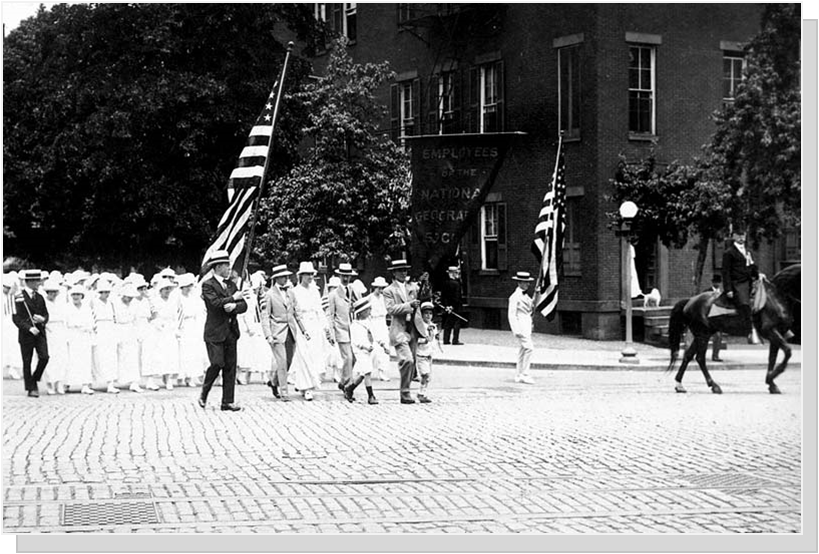
Washington, DC: 1916
Citizens are marching to prepare for war, the suffragette movement, and for keeping everything exactly as it is. Social structures begin to change in favor of higher education for women, and for questioning even the US President's right to hold women back.
Preparedness Marches paraded in many US cities, including Washington pictured above during 1916. The cause had opponents from radical circles claiming that war would encourage many a business to profit off the carnage. Other opponents objected because they believed that WWI should be left a battle between capitalists and emperors, not the working man. This war was a European struggle and should not be fought with American blood. Those with the preparedness movement saw American involvement as inevitable and wanted the country’s industrial strength to turn toward a war footing sooner so American soldiers would be best armed and supplied. They also wanted to encourage the American public to prepare.
The Suffrage Movement continued to headline the news with more and more rallies and protests, especially in Washington against President Wilson’s opposition. By 1916, suffragettes encouraged more women to seek training in industrial settings preparing for their role in WWI and to seek higher educations. Many found a home at George Washington University.
Organized youth groups, particularly the scouts, arranged awareness drives collecting peach pits which were turned into carbon for gas mask filters. The US was sending gas masks to Britain along with food and necessary supplies.
The Fifty-fourth annual convention of ex-slaves was held at the Cosmopolitan Baptist Church on Tenth and N Streets NW from October 22 through November 6, 1916, presided over by Dr. Simon Drew, Pastor of the church. A dinner was served each day for the participants. Former slaves of Gen. Robert E. Lee and Stonewall Jackson were present.
President Wilson and candidates running for president were invited to speak, but no record can be found to indicate who accepted.
IN FLANDERS FIELDS
in Flanders fields the poppies blow
Between the crosses, row on row,
That mark our place; and in the sky
The larks, still bravely singing, fly
Scarce heard amid the guns below.
We are the Dead. Short days ago
We lived, felt dawn, saw sunset glow,
Loved and were loved, and now we lie
In Flanders fields.
Take up our quarrel with the foe:
To you from failing hands we throw
The torch; be yours to hold it high.
If ye break faith with us who die
We shall not sleep, though poppies grow
In Flanders fields. ~ Major John McCrae, Canadian
Reproduction of this story and photographs, in part or in whole, requires the written permission of the author. Copyright © 2011 Annandale Chamber of Commerce. All rights reserved.
(Photographs, on this page, and on this website, are the sole property of the Annandale Chamber of Commerce, and are not available for use by other publications, blogs, individuals, web or social media sites.)
War News 1916




Photographs, not already noted, are from the Library of Congress.